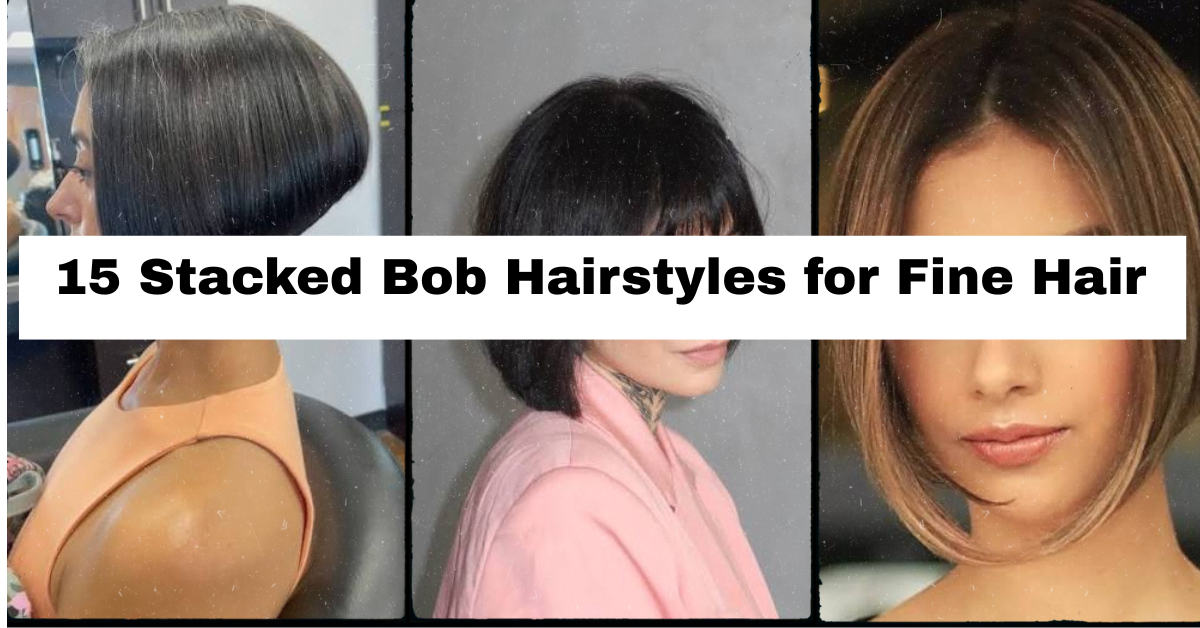
15 Stacked Bob Hairstyles for Fine Hair
For years, I’ve had thin-haired clients tell me this exact thing while sitting in my chair: “I want volume, but nothing ever works for me.” The right stacked bob haircut may just be what you need, and I’ll explain everything about why!
Then what are the best stacked bob hairstyles for fine hair? The best stacked bob hairstyles for fine hair incorporate graduated layering at the nape, weight in the crown area, and chin-to-jaw length to give an impression of thickness. The blunt ends and short layering at the back contribute to the thickening effect without additional products.
Did you ever wonder why some bobs seem flat by lunchtime while others keep their bounce until bed? Don’t worry, because I’m going to explain 15 stacked bob haircuts, along with their cuts, color ideas, and tools used!
What Makes a Stacked Bob Different (And Why Fine Hair Loves It)
A stacked bob is not merely a short hairstyle. Rather, this is an approach to cutting hair where layers are ‘stacked’ along the bottom section of the hair, with the back often being shorter and gradually getting longer towards the front. This will give you volume and roundness in the places where fine hair lacks it the most.
In other words, layers are laid down on top of each other, allowing building up more thickness where needed. Unlike some coloring techniques or hair care products, this will add real volume to thin and fine hair without having to tease it.
Of course, the face shape plays an important role here as well. Those who have oval and heart-shaped faces can go with any stacking line. For people with round features, longer layers at the front should cover the jawline. The square face shape will be best suited for soft and textured end lines.
Below, we will discuss 15 types of stacked bob cuts, which will suit various lifestyles and hair conditions.
1. Classic Graduated Stacked Bob
This is the OG stacked bob, and there’s a good reason why it has been popular for decades. The back of this hairstyle features a very short and close cut, gradually getting longer towards the front side of the hair and framing the face. The degree of the graduation angle which is typically in between 45 and 90 degrees helps form a rounded shape on the top.
If you have fine hair, then you should ask your stylist to form more lift with this haircut by keeping the stacking closer to 90 degrees. Blow dry your hair straight with the help of a round brush using light-hold mousse. If your hair is curly or wavy fine hair then this stacked bob looks gorgeous too; just remember to use a diffuser.
This hairstyle looks fantastic for any workplace environment or weekend outings. It is quite easy to maintain once it is cut right and requires regular trimming only once in six-eight weeks. So, what would happen if we added some edge to this classic cut?
2. Asymmetrical Stacked Bob
Asymmetry breaks the predictability of a standard bob while still using the stacking technique for volume. One side sits longer than the other, often by an inch or two, creating movement and a slightly edgy vibe.
Fine hair benefits from asymmetry because the uneven weight distribution naturally creates the appearance of more density on one side, drawing the eye and adding dimension. This cut suits oval, heart, and diamond face shapes especially well since the diagonal line balances angular features.
Style it with a flat iron for sleek definition, or add loose waves with a 1-inch curling wand for a softer finish. A texturizing spray at the roots keeps things from looking too polished or stiff. This is a fantastic transitional cut if you’re bored with symmetry but not ready for anything too dramatic. Speaking of drama, let’s crank it up a notch.
3. Angled Stacked Bob with Long Front Pieces
Here, the back stays short and stacked while the front pieces extend well past the chin, sometimes to the collarbone. This dramatic length difference creates a striking silhouette that photographs incredibly well.
This is one of my favorite recommendations for fine hair because the long front pieces can be curled or waved to add textural volume exactly where thinning is most noticeable — around the face. Use a curling iron with a 1-inch barrel and alternate curl direction for a naturally piecey finish.
Round and square face shapes look fantastic with this style since the elongated front breaks up width. It requires slightly more upkeep than a classic stack, with trims every 6 weeks to maintain the length contrast. Formal events call for this one — the drama alone makes it event-ready. Now, let’s soften things up.
4. Soft, Textured Stacked Bob
Not everyone wants sharp lines and heavy graduation. This version uses point-cutting and razor techniques to soften the stacked layers, creating a feathered, lived-in look rather than a rigid shape.
Fine hair actually thrives with this texturizing method because removing weight at the ends (without removing length) prevents the hair from looking stringy or overly thin at the tips. Ask your stylist specifically for “point cutting” rather than blunt shears on the ends.
This cut pairs beautifully with beachy waves using a texturizing spray and a flat iron for loose S-waves. It’s ideal for casual, everyday wear and requires minimal styling time — a huge win if you’re not a morning person. Let’s move to something with a bit more shine and polish.
5. Sleek Stacked Bob with Blunt Ends
If soft and textured isn’t your vibe, the sleek blunt-ended version is the polar opposite. Every layer ends crisply, creating a polished, almost architectural look. The stacking still lives underneath, giving lift at the crown, but the surface reads smooth and controlled.
This style genuinely fools people into thinking fine hair is thick. Blunt ends reflect more light than feathered ones, and that light reflection reads as density. A ceramic flat iron and a shine serum (not oil, which weighs fine hair down) are your best friends here.
This is a fantastic corporate or formal look. It’s less forgiving on wash day two or three, though, so plan on a dry shampoo refresh or a quick reflat-iron touch-up. Next, let’s talk color, because a stacked bob without the right shade is only half the equation.
6. Stacked Bob with Balayage Highlights
Cut alone can only do so much. Adding balayage — hand-painted, graduated highlights — creates dimension that a single flat color never will. For stacked bobs specifically, placing lighter pieces on the top layers (rather than underneath) maximizes the illusion of depth and movement created by the cut.
This is huge for fine hair because multi-tonal color tricks the eye into seeing more strands than are actually there. Ask your colorist for “face-framing balayage” combined with subtle babylights throughout the crown.
Warm balayage (honey, caramel, golden blonde) suits warmer skin tones, while cool balayage (ash blonde, cool brown) suits cooler undertones. This combo works for nearly every occasion — it’s polished enough for work, pretty enough for events. Maintenance sits around every 3-4 months for touch-ups. Now let’s go bolder with color.
7. Stacked Bob with Root Shadow (Shadow Root Technique)
A shadow root — a soft, deliberately darker root that blends into a lighter mid-shaft and end color — does wonders for fine hair’s biggest enemy: visible scalp at the part line. The darker root creates the illusion of a fuller base, since scalp and dark roots visually blend together.
This technique pairs exceptionally well with the stacked bob because the graduated cut already draws attention to the crown. Adding shadow root there makes the whole style look intentional and dimensional, not thin.
This works on straight or wavy fine hair equally well and stretches out root-touch-up appointments to every 10-12 weeks, since regrowth blends naturally. It’s a genuinely low-maintenance color option for busy women. From color, let’s shift to a length variation.
8. Chin-Length Stacked Bob
Shorter is often better for fine hair, and the chin-length stack proves it. Hitting right at or just above the chin, this length keeps hair from getting weighed down by its own gravity — a real problem for longer fine styles that go limp by afternoon.
The stacking at the back stays compact and tight here, maximizing volume in a smaller overall silhouette. This length suits oval, heart, and inverted triangle face shapes best, framing the jaw without adding width.
A small round brush (1-inch barrel) during blow-drying creates the necessary lift, finished with a volumizing mousse applied at the roots only. This length is wonderfully low-maintenance for busy schedules — quick to wash, quick to dry, quick to style. Let’s go a touch longer next.
9. Long Stacked Bob (Lob) with Layers
For those not ready to commit to short hair, the long stacked bob — or “lob” — extends to the collarbone while still incorporating stacked layering underneath to prevent that flat, pancake look longer fine hair often falls into.
The key here is internal layering rather than visible surface layers. Your stylist should thin out the underneath sections while keeping the top layer fuller, creating shape without cutting visible steps into the length.
This length works for nearly all face shapes and is incredibly versatile — sleek for the office, wavy for weekends, half-up for errands. A lightweight sea salt spray adds texture without the heaviness that sinks fine hair. This one bridges the gap between short and long beautifully. Now, let’s talk about a stack built for curls.
10. Curly Stacked Bob
Curly fine hair faces a unique challenge: individual strands are thin, but the curl pattern can create the illusion of thickness — if cut correctly. A curly stacked bob uses the same graduation principle but relies on a dry cut (cutting curls in their natural state) to see exactly how each curl falls.
The stacking here isn’t as visually obvious as with straight hair since curls naturally create their own volume and shape. But the underlying technique still lifts the crown and prevents the “triangle” shape many curly bobs fall into.
A curl cream (not gel, which can weigh down fine curls) scrunched in while damp, then air-dried or diffused, brings out the best texture. This style is genuinely low-maintenance for curly girls — wash, product, go. Straight or wavy hair can’t replicate this exact volume pattern, which is part of what makes it special. Let’s look at an angled variation next.
11. Inverted Stacked Bob
The inverted bob takes the stacking concept and flips the angle — shorter in the front, longer in the back, with heavy graduation at the nape creating serious volume where fine hair typically thins out most: the back of the head.
This is one of the more dramatic stacked options and works incredibly well for fine, straight hair since the sharp angle needs minimal texture to look intentional. Round and oval faces suit this cut particularly well.
Style with a flat iron for a crisp, geometric finish, or leave slightly tousled with a texturizing spray for a softer take. This cut demands trims every 5-6 weeks to maintain its sharp lines, making it a higher-maintenance choice — but the volume payoff is significant. Let’s dial things back to something easier to manage.
12. Low-Maintenance Wash-and-Go Stacked Bob
Not everyone has 20 minutes to blow-dry every morning, and that’s okay. This version of the stacked bob is cut specifically to fall into place with minimal styling — the layers do the work, not your styling tools.
The trick is asking your stylist for a slightly shorter, tighter stack with more graduation than usual, since this natural lift compensates for skipping the round brush routine. A leave-in conditioner followed by a light mousse, scrunched in while damp, is really all this style needs.
This is ideal for fine, straight-to-wavy hair and works for basically any occasion where you don’t have styling time to spare — school mornings, early flights, gym days. It’s proof that fine hair doesn’t require hours of effort to look full. Now, let’s add some bangs into the mix.
13. Stacked Bob with Curtain Bangs
Curtain bangs — face-framing, center-parted pieces that sweep to either side — pair beautifully with a stacked bob because they add softness at the front while the stack handles volume at the back and crown.
For fine hair, curtain bangs should be cut with slightly more length than typical (brushing the cheekbone rather than the eyebrow) to avoid looking sparse. Fine hair bangs need length to have movement; too short and they’ll look flat and thin.
A round brush blow-dry technique, curling the bangs away from the face, creates the classic curtain sweep. This combo suits round, square, and oval face shapes and works for both casual and dressed-up looks. It’s a great option if you want face-framing softness without committing to full bangs. Let’s try a shaggier take next.
14. Shag-Influenced Stacked Bob
Merging shag layering with the stacking technique creates a textured, rock-and-roll edge that’s currently trending hard. Choppy, disconnected layers throughout combine with the classic nape stacking for volume that looks effortlessly undone rather than deliberately styled.
Fine hair handles this surprisingly well because the piecey, textured ends distract from any thinness while the underlying stack still provides real structural lift. Heavy texturizing with thinning shears or a razor is key to getting the “shaggy” quality right.
A texture paste or clay (used sparingly — fine hair hates heavy products) scrunched through dry hair enhances the piecey finish. This is a fantastic casual, everyday style with genuine personality, perfect for those wanting something less “done” than a classic stacked bob. Finally, let’s finish with a versatile in-between option.
15. Medium Stacked Bob with Face-Framing Layers
This one sits between short and long — typically jaw to just-below-chin length — with subtle face-framing layers cut into the front sections. The stacking remains concentrated at the back and crown, while the front pieces are left slightly longer to soften the jawline.
This is genuinely one of the most versatile stacked bob variations for fine hair, since the medium length keeps hair light enough to avoid weighing down the volume, while still offering enough length for a few styling options — sleek, wavy, or half-up.
It flatters nearly every face shape and works for work, casual days, and dressier occasions alike with just a change in styling approach. A lightweight volumizing spray at the roots and a loose curl throughout keeps this look adaptable all week long.
Stacked Bob Comparison Table
| Style | Best For Face Shape | Hair Texture | Maintenance Level | Trim Frequency |
|---|---|---|---|---|
| Classic Graduated | Oval, Round | Straight, Wavy | Low | 6-8 weeks |
| Asymmetrical | Oval, Heart, Diamond | Straight, Wavy | Medium | 6-7 weeks |
| Angled w/ Long Front | Round, Square | Straight, Wavy | Medium | 6 weeks |
| Soft Textured | All shapes | Straight, Wavy, Curly | Low | 8 weeks |
| Sleek Blunt | Oval, Heart | Straight | Medium-High | 6 weeks |
| Chin-Length | Oval, Heart, Inverted Triangle | Straight, Wavy | Low | 6-8 weeks |
| Long Bob (Lob) | All shapes | Straight, Wavy | Low | 8-10 weeks |
| Curly Stacked | Round, Oval | Curly | Low | 8-10 weeks |
| Inverted | Round, Oval | Straight | High | 5-6 weeks |
| Wash-and-Go | All shapes | Straight, Wavy | Very Low | 8 weeks |
| Curtain Bangs Stack | Round, Square, Oval | Straight, Wavy | Medium | 5-6 weeks |
| Shag-Influenced | Oval, Heart | All textures | Medium | 6-8 weeks |
| Face-Framing Medium | All shapes | Straight, Wavy | Low | 7-8 weeks |
Tips for Success
Getting a stacked bob to actually look good on fine hair isn’t just about the cut — it’s about the follow-through. Here’s what actually works:
- Ask for “point cutting” instead of blunt shears if you want softer ends without losing density
- Use a boar bristle round brush for blow-drying; it creates smoother volume than plastic bristles
- Apply volumizing product to roots only — mid-shaft and ends just weigh fine hair down
- Get regular trims. Stacked layers grow out fast and lose their shape within 6-8 weeks
- Consider a clarifying shampoo weekly to remove product buildup that flattens fine strands
- Sleep on a silk pillowcase to reduce friction and preserve your blow-dry longer
Common Mistakes and How to Avoid Them
Mistake: Going too short at the nape without discussing graduation angle with your stylist.
Fix: Bring reference photos and specifically ask for “heavy stacking” if you want maximum volume.
Mistake: Using heavy oils or creams meant for thick hair.
Fix: Switch to lightweight, silicone-free volumizing products designed specifically for fine strands.
Mistake: Skipping regular trims because “it still looks fine.”
Fix: Stacked layers rely on precision. Even slight growth blurs the shape — stick to your trim schedule.
Mistake: Over-washing, which strips natural oils and makes fine hair look even thinner.
Fix: Stretch washes with dry shampoo and only wash 2-3 times weekly unless your scalp is very oily.
Mistake: Choosing an all-one-color shade with a stacked cut.
Fix: Add balayage, babylights, or a shadow root to enhance the dimensional effect the cut is designed to create.
Final Thoughts
A stacked bob genuinely might be the most reliable haircut for anyone dealing with fine, thin-feeling hair. The layering technique does the heavy lifting that products alone simply can’t achieve, and with 15 variations to choose from, there’s a version here for every lifestyle, face shape, and maintenance preference.
Whether you go sleek and blunt or soft and shaggy, remember that the cut is only half the story — the right products, tools, and trim schedule keep your stacked bob looking its absolute best. Bring this guide to your next salon appointment, and walk out with a stacked bob that finally makes fine hair look like it’s anything but.